
COIN #217. Recursive Intelligence Is Not Recursive Value
What happens when AI begins building itself?

Venkat Ramaswamy
The announcement was striking. Anthropic recently published a provocative essay titled When AI Builds Itself, documenting how AI systems are increasingly participating in their own development. Claude now writes much of the code used inside Anthropic, runs experiments, proposes new experiments, evaluates results, and contributes to the research process itself. The trajectory they describe points toward a possibility long discussed in AI circles: recursive self-improvement—AI systems designing increasingly capable successors.
If that trajectory continues, intelligence production could begin accelerating itself. The implications are profound.
Yet reading the essay, I found myself asking a different question:
What if recursive intelligence is not the same thing as recursive value?
This distinction may become one of the most important questions of the coming decade.
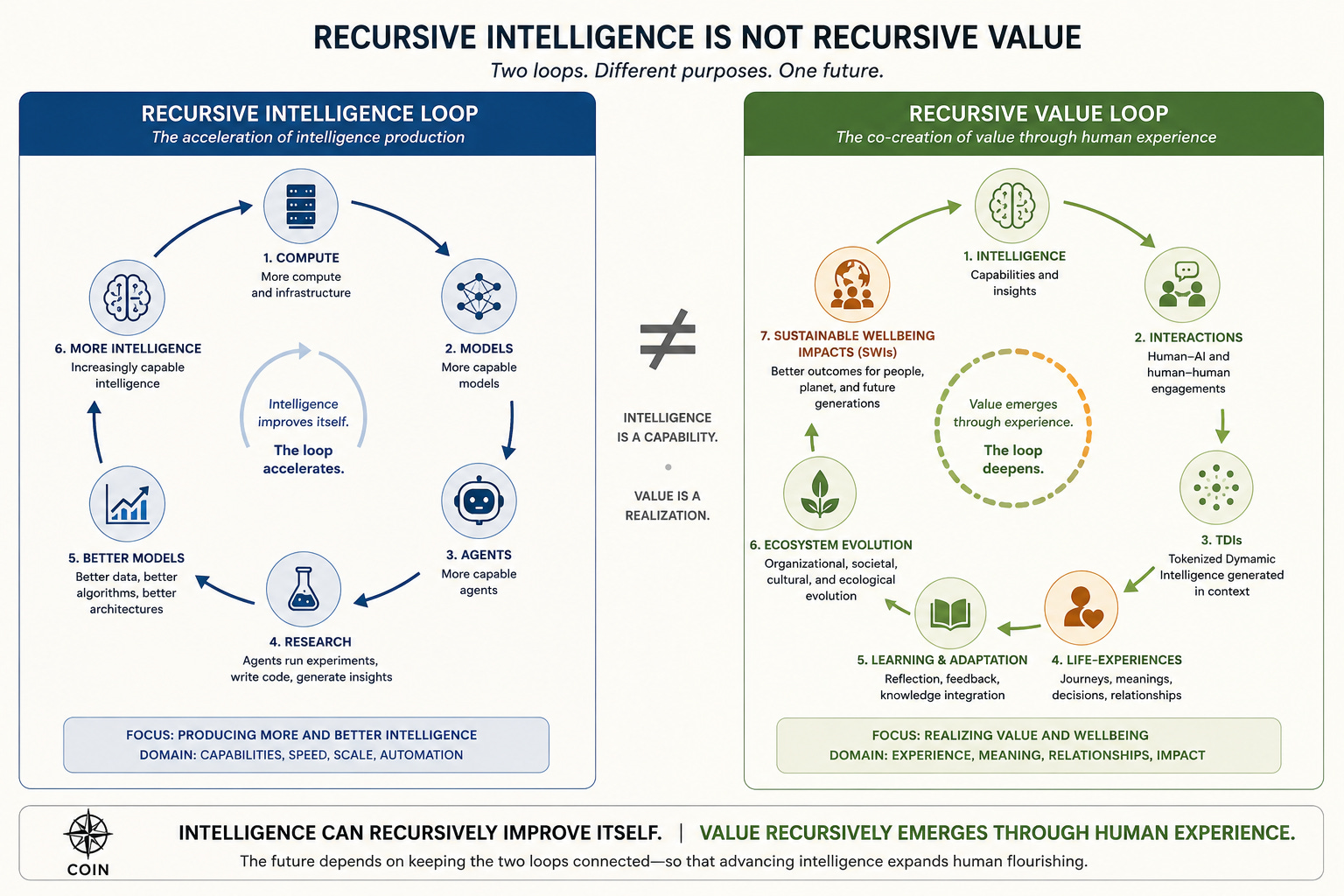
For most of modern economic history, we have implicitly assumed that more intelligence automatically produces more value. Better ideas create better products. Better products create better experiences. Better experiences create better outcomes.
But the age of co-intelligence forces us to separate these assumptions.
Intelligence is not value.
Intelligence is a capability.
Value is a realization.
The difference matters.
An AI system may become dramatically better at writing code. It may design experiments more effectively than human researchers. It may optimize architectures, discover new algorithms, and eventually contribute to building its own successors.
All of these represent advances in the production of intelligence.
Yet none of them, by themselves, constitute value.
Value emerges only when intelligence enters the world of human experience.
A medical breakthrough becomes valuable when it improves health.
An educational breakthrough becomes valuable when it improves learning.
A scientific breakthrough becomes valuable when it expands human understanding.
An organizational breakthrough becomes valuable when it enhances human and societal flourishing.
Intelligence creates possibility. Experience realizes value.
This distinction sits at the heart of the COIN framework.
The contemporary discussion surrounding AI often focuses on intelligence production: larger models, better reasoning, autonomous agents, scientific discovery, and recursive self-improvement. These developments are undeniably important. They represent extraordinary advances in our capacity to generate knowledge and solve problems.
Yet the ultimate question is not how much intelligence we can produce.
The ultimate question is what that intelligence enables us to become.
The COIN Systems Architecture reminds us that intelligence is only one layer of a larger value realization process.
Shared digitalized infrastructures create the foundation.
Machinic cognition generates intelligence.
Humans and AI interact through evolving forms of co-agency.
These interactions generate Tokenized Dynamic Intelligence (TDIs).
Those TDIs shape journeys, experiences, meanings, decisions, and relationships.
Only then do they influence ecosystem evolution and sustainable wellbeing impacts.
The production of intelligence occurs upstream. The realization of value occurs downstream.
Anthropic’s essay is largely a story about upstream acceleration. The deeper societal challenge lies downstream.
Interestingly, the essay itself hints at this tension.
One employee reflects on how work once operated through a “gift economy of small favors between humans.” A request for help created not merely a solution but a relationship. A debt. A connection. A shared understanding.
AI performs many of these tasks faster and more efficiently. Yet efficiency and meaning are not identical.
Every interaction removed from human collaboration may increase productivity while simultaneously altering the social fabric through which trust, mentorship, belonging, and identity are created.
This is not an argument against AI. It is an argument for seeing more clearly that the future is not merely about intelligence. It is about the relationship between intelligence and experience.
This becomes even more important if recursive self-improvement eventually becomes possible.
Much of the public discussion imagines recursive self-improvement as AI somehow escaping the human network and entering a separate evolutionary process.
But that framing misunderstands how value emerges.
Even a recursively self-improving AI remains embedded within human institutions, economies, governance systems, legal frameworks, cultural norms, and ecological realities.
Intelligence may run at the speed of compute. Meaning does not.
Trust does not. Legitimacy does not.
Relationships do not. Governance does not.
Human experience evolves according to different rhythms than machine optimization.
This is why recursive intelligence remains embedded within a larger co-intelligence system.
The question is not whether AI can become increasingly intelligent. The evidence increasingly suggests it can.
The question is whether recursive intelligence remains connected to recursive value creation.
Can increasingly autonomous intelligence remain aligned with the experiences, aspirations, and wellbeing of people?
Can it strengthen relationships rather than merely replace interactions?
Can it expand human agency rather than diminish it?
Can it help societies flourish rather than simply optimize?
These are not merely technical questions. They are questions of co-design.
Questions of governance. Questions of experience. Questions of meaning.
The future may indeed belong to recursive intelligence. But humanity’s future will be determined by something larger.
Not how fast intelligence improves itself. But how effectively intelligence participates in the co-creation of value.
Recursive intelligence may become one of the defining capabilities of the twenty-first century.
Recursive value creation may determine whether that century becomes one of flourishing or fragmentation.
The challenge before us is not simply building smarter systems. It is ensuring that every advance in intelligence remains connected to the human experiences, relationships, ecosystems, and wellbeing outcomes through which value is ultimately realized.
Because intelligence can improve itself.
But value must still be lived.