
COIN #220. Beyond Token Consumption: How Tokens become Token Capital—and Token Capital becomes Value
From Jensen Huang to Satya Nadella to the Next Frontier of the Intelligence Economy

Venkat Ramaswamy
In COIN #152, Tokenomics and the Rise of the Intelligence Production Economy, I argued that we are witnessing the emergence of a new economic system—one in which intelligence itself is becoming computable, producible, and industrialized.
At NVIDIA’s GTC keynote, Jensen Huang captured this transformation with a deceptively simple formulation: Energy goes in. Tokens come out.
In a single sentence, Jensen described the emergence of what may become one of the defining production systems of the Intelligence Age.
AI factories transform energy, compute, and data into tokens—the fundamental units of machine-generated intelligence.
For the first time in history, intelligence is being produced industrially.
But that insight immediately raises a deeper question:
What happens after the token is produced?
Because production is only the beginning of the story.
The First Phase of the Intelligence Economy
The first phase of the Intelligence Economy is about producing intelligence.
This is the world of AI factories. This is the world of GPUs, accelerated computing, foundation models, inference engines, and tokens. This is the world Jensen Huang has helped make visible.
Its central question is:
How do we produce intelligence efficiently and at scale?
This remains an enormously important question.
But increasingly, it is no longer the only question.
A second phase is now emerging.
The Token Consumption Era
Across organizations, a new executive vocabulary has appeared almost overnight.
Token budgets. Token spending. Token governance. Token efficiency. Token-maxing.
Tokenomics.
Executives are now monitoring token consumption the same way previous generations monitored cloud expenditure, labor costs, or energy consumption.
This is understandable. Tokens have become measurable. Tokens have become economic. Tokens have become manageable.
But most conversations remain focused on consumption.
How many tokens are we using? How much are they costing? How can we reduce token expenditure?
These are important questions. Yet they still focus primarily on managerial inputs.
They focus on what is being used. Not on what is being created.
The Real Executive Question
The future advantage will not come from consuming more tokens. Nor will it come from consuming fewer tokens. Those are optimization questions.
The strategic question is different:
How do we convert token consumption into value?
This is where many discussions of tokenomics stop too early.
A token has a cost. A token can be measured. A token can be consumed. A token can be priced.
But a token by itself creates no value.
Just as electricity creates no value sitting in a wire.
Just as financial capital creates no value sitting in a bank account.
Just as data creates no value sitting in a database.
Potential value is NOT realized value.
Something else must happen.
From Tokens to Token Capital
Satya Nadella has increasingly described tokens as a new form of capital.
This is a profound observation.
Throughout history, organizations have relied upon different forms of capital:
Financial capital
Physical capital
Human capital
Intellectual capital
Social capital
Now another form is emerging:
Token capital.
But token capital is not simply a stockpile of tokens.
Tokens become capital only when they are directed toward value creation.
Capital, by definition, is productive. It participates in the creation of future value.
A pile of unused tokens is not token capital. Just as cash under a mattress is not productive capital.
Tokens become capital when they are embedded into workflows, decisions, offerings, experiences, and interactions.
The moment intelligence begins doing productive work, tokens become token capital.
The Missing Layer in Tokenomics
This is where a crucial distinction emerges.
Most discussions focus on two things:
Token Production
and
Token ConsumptionCOIN introduces a third:
Token Realization
How does consumed intelligence become realized value?
This is where Tokenized Dynamic Intelligence (TDI) enters the picture.
A TDI is not a different kind of token. The token itself has not changed.
What changes is its role.
A token becomes part of a TDI when it becomes embedded within a real-world interaction among people, AI systems, organizations, and ecosystems.
The token becomes contextual.
The token becomes relational.
The token becomes dynamic.
The token becomes value creating.
A simple way to think about it is this:
Tokens are the raw material of intelligence production. Token capital is intelligence put to work.
TDIs are the dynamic manifestations of that intelligence inside value-creating interactions.
Value is what that intelligence ultimately creates.
This is the missing bridge between tokenomics and value creation.
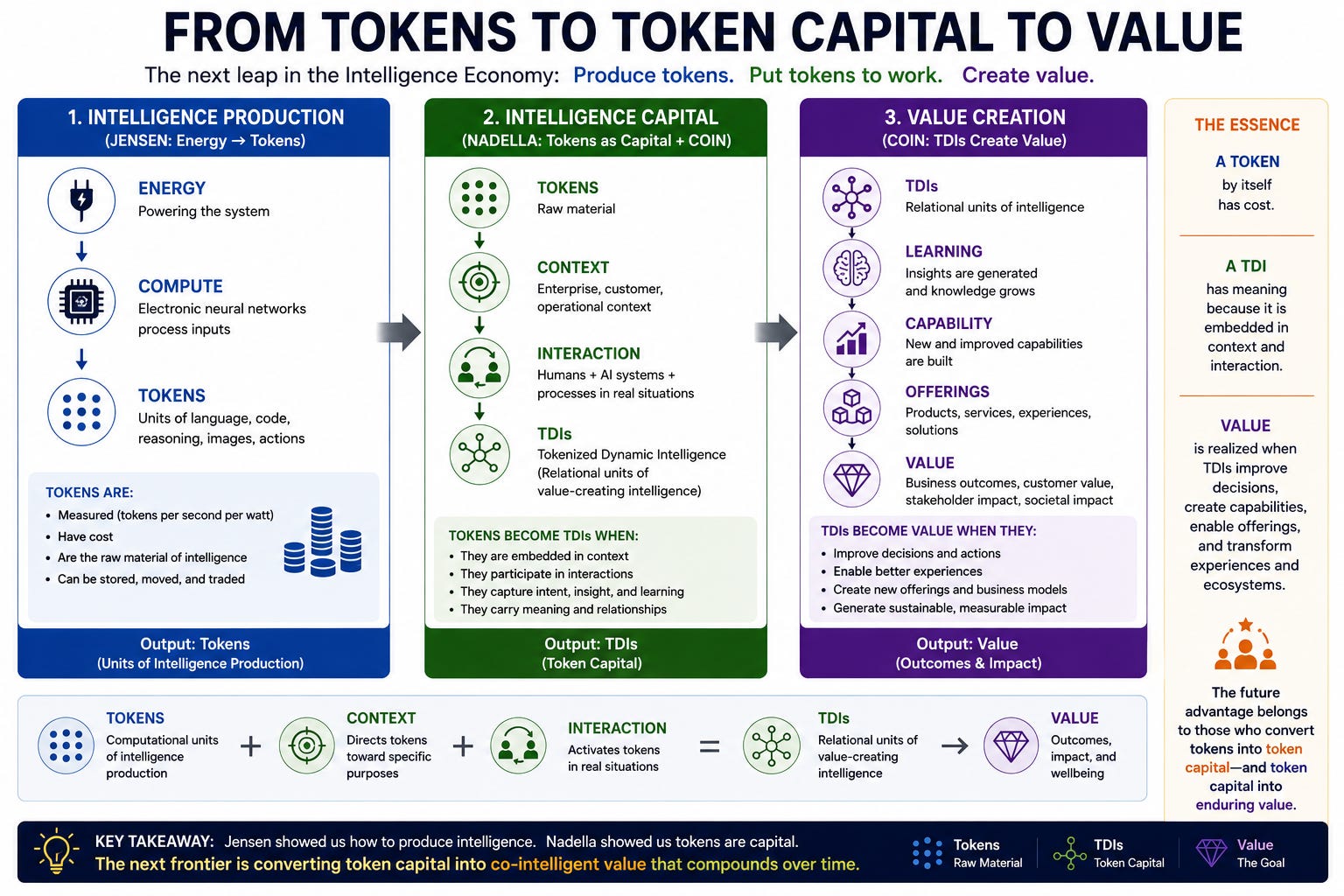
The Three Layers of the Intelligence Economy
The emerging Intelligence Economy can be understood as three interconnected layers.
Layer 1: Intelligence Production
Energy → Compute → Tokens
This is Jensen’s world.
The production of intelligence.
The AI factory.
The economics of compute.
The economics of token generation.
Layer 2: Intelligence Capital
Tokens → Context → Interaction → TDIs
This is the conversion layer.
The point at which tokens become productive assets.
The point at which intelligence enters workflows, decisions, experiences, and relationships.
The point at which token consumption becomes token capital.
Layer 3: Value Creation
TDIs → Learning → Capability → Offerings → Value
This is where organizations actually compete.
Learning accumulates.
Capabilities evolve.
Experiences improve.
Offerings become more intelligent.
Organizations become more adaptive.
Ecosystems become more connected.
Value is realized.
The New Productivity Equation
Most organizations remain focused on token efficiency.
How can we lower costs?
How can we optimize prompts?
How can we reduce token consumption?
These questions matter.
But they focus largely on the denominator.
The leaders of the Intelligence Age will focus on something different.
They will ask:
How can we create more value from every token consumed?
The future advantage will not come from consuming the most tokens.
Nor from minimizing token consumption.
It will come from achieving the highest conversion rate:
Token Consumption → Token Capital → Value
Or more specifically:
Tokens → TDIs → Value
This may become the defining productivity equation of the Intelligence Age.
The New Strategic Question for Future Leaders
The Industrial Age asked:
How do we convert raw materials into products?
The Information Age asked:
How do we convert data into insights?
The Intelligence Age introduces a new challenge:
How do we convert token consumption into value?
This question will increasingly shape enterprise strategy, leadership, innovation, operating models, and public policy.
Because as intelligence becomes abundant, competitive advantage shifts.
Not to producing intelligence.
Not to consuming intelligence.
But to realizing value with intelligence.
Not to generating tokens. But to converting token capital into enduring value.
The COIN Perspective
The Co-Intelligence Revolution is not fundamentally about AI. It is fundamentally about value creation.
AI factories may produce tokens.
Organizations create value.
Interactions create value.
Ecosystems create value.
The organizations that thrive in the Intelligence Age will be those that learn
how to transform computable intelligence into co-intelligent value.
The sequence is remarkably simple:
Produce intelligence. Put intelligence to work. Create value.
Jensen Huang helped us understand how intelligence is produced.
Satya Nadella is helping us understand why tokens are becoming a new form of capital.
The next frontier is understanding how token capital becomes value that compounds across people, organizations, ecosystems, and society.
That is where the real opportunity lies. And that journey has only just begun.
COIN Takeaway
Jensen showed us how intelligence is produced.
Nadella showed us why tokens are becoming a new form of capital.
The next challenge for future leaders is learning how to convert token consumption into token capital—and token capital into enduring value.